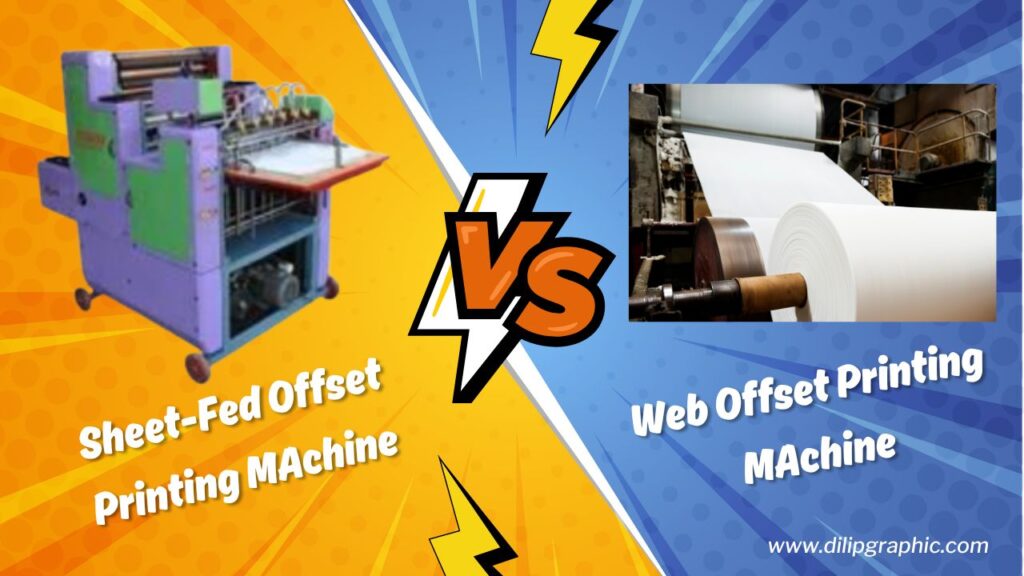
In today’s fast-paced printing industry, choosing the right printing method is crucial for delivering high-quality results efficiently. Among the most popular technologies are sheet-fed and web offset printing machines, each designed for specific production needs. In this blog, we’ll explore the key differences between the two and help you understand which method best suits your business.
1. Understanding the Basics
What is Offset Printing?
Offset printing is a widely-used commercial printing technique where ink is transferred from a plate to a rubber blanket, and then to paper. It offers exceptional print clarity, consistency, and cost-effectiveness for medium to large-volume jobs.
Sheet-Fed vs Web Offset: An Overview
Both sheet-fed and web offset machines use the offset technique, but they differ significantly in how the paper is fed, processed, and handled.
2. What is Sheet-Fed Offset Printing?
Definition
Sheet-fed offset printing involves feeding individual sheets of paper into the press. Each sheet is printed on separately, making it ideal for high-resolution, precision work.
How It Works
Sheets are picked up one at a time from a stack, passed through the press, and printed with great detail and color accuracy.
Key Advantages
Superior Image Quality: Offers crisp images with high color fidelity.
Flexible Substrate Options: Supports various paper types, textures, and thicknesses.
Ideal for Short to Medium Runs: Economical for print jobs like brochures, flyers, and art books.
Common Uses
Sheet-fed printing machines are often used to print items like business cards, magazines, posters, and packaging boxes.
3. What is Web Offset Printing?
Definition
Web offset printing is a high-speed process where a long roll of paper, known as a “web,” is continuously fed through the printing press. This allows for fast and efficient printing, especially for large-volume jobs.
How It Works
The paper roll moves through the press without interruption and is cut or folded post-printing, making the process highly efficient for large-volume production.
Key Advantages
High-Speed Production: Capable of printing thousands of impressions per hour.
Lower Cost Per Copy: Ideal for high-volume print jobs due to economies of scale.
Continuous Operation: Minimal manual intervention required once the process starts.
Common Uses
Web offset printing is mainly used for printing newspapers, books, catalogs, and large quantities of mailers.
4. Key Differences Between Sheet-Fed and Web Offset Printing
Now that your machine is set up, follow these key steps:
Start the Press: Power on the machine and let it warm up.
Feed the Paper: Adjust feed settings to avoid jams or misfeeds.
Monitor the Output: Check alignment, color consistency, and sharpness.
Make Adjustments: Fine-tune pressure and ink levels as needed.
5. Choosing the Right Printing Method for Your Project
Consider Your Project Needs:
Volume: For small to medium-sized batches, sheet-fed is often better. For high-volume, repetitive jobs, web offset offers cost and time advantages.
Quality Requirements: Choose sheet-fed for photo-rich, vibrant, and color-accurate prints.
Budget: Web offset can save costs on bulk printing, while sheet-fed is ideal when quality trumps quantity.
Turnaround Time: Web presses are faster, but sheet-fed can be quicker for low-volume jobs due to simpler setup.
Conclusion
Understanding the difference between sheet-fed and web offset printing machines can save time, money, and ensure the best outcome for your project. While sheet-fed presses offer premium quality and versatility, web offset presses deliver speed and cost-efficiency for large-scale needs.
Frequently Asked Questions
Q1. How do sheet-fed and web offset printing differ from each other?
The main difference lies in the paper feeding method—sheet-fed uses individual sheets, while web offset uses a continuous roll of paper.
Q2. Which offset printing method offers better quality?
Sheet-fed printing generally provides higher image quality, especially for detailed and color-rich projects.
Q3. When should I use web offset printing?
Web offset is ideal for high-volume projects like newspapers, catalogs, and books due to its speed and lower cost per unit.
Q4. Is sheet-fed printing more expensive than web offset?
For smaller print runs, sheet-fed can be more economical. However, for bulk printing, web offset offers better cost-efficiency.
Q5. Can both sheet-fed printing and web offset printing methods print in color?
Yes, both sheet-fed and web offset printing support full-color (CMYK) printing.
Q6. What types of materials can be printed using sheet-fed machines?
Sheet-fed presses can handle a wide range of paper types, including thick, textured, or specialty substrates.
Q7. Which printing method is faster, sheet-fed printing or web offset printing?
Web offset printing is significantly faster and suited for long-run, continuous print jobs
Q8. Can I use web offset for custom-sized prints?
Web offset is less flexible in terms of size and paper type compared to sheet-fed printing, which is better for custom and premium jobs
Q9. How do I choose the right printing method for my project?
Consider factors like volume, quality, budget, and turnaround time. Sheet-fed is great for quality-focused short runs, while web offset suits fast, large-scale printing.